




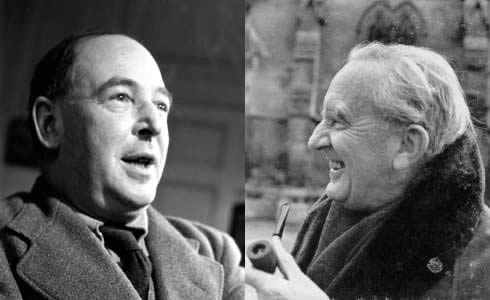
Lewis definitely wanted his Chronicles to be a direct allegory for God and Jesus. The parallels are clear throughout all seven books. There are also parallels in his science fiction series - Out of the Silent Planet, Perelandra, and That Hideous Strength - to God, creationism, and explorations of original sin. I once heard a kid call in to a radio program asking if it was wrong for them to love Aslan more than they loved Jesus. Of course, the Dr. Dobson-type told them that was fine, since Lewis meant for Aslan to represent Jesus. (I'm not sure what exactly qualified the radio host to make this assurance, but the kid did stop crying).
Tolkien, on the other hand, always insisted that while his works were spiritual, he did not want to stoop to direct allegory. He famously frowned on Lewis for doing so. Reading the Lord of the Rings and its accompanying books can indeed be a profoundly spiritual experience, but there is no direct God metaphor readily available for interpretation.
While I in no way am comparing myself and my work to these huge role models of writing, they way they think about the issue of spirituality in fiction has influenced me and my decision on what to include in what I write. When I was thirteen, I tried really really hard to write a mystical story involving a Jesus-type person and what I got was a thirteen year old's plagiarism of Narnia. I'm pretty sure copying a famous fantasy work as a tween is a rite of passage for every single person who calls themselves a writer. However, what I discovered from my clumsy terrible attempts is that I don't really enjoy writing a centralized God-figure in my fiction work.
I've dabbled in the spiritual genre before. In high school I wrote a short story involving a little trip through what I imagined the spiritual realm to look like. I don't feel uncomfortable involving God and my Christian faith in that sort of writing because I'm directly communicating my ideas about spirituality and God and how that fits into the universe.
When I'm writing in the fantasy genre, I just can't manage it. No matter how hard I try to. It took me a while to recognize that it's really okay if I don't want to write "Jesus Jesus Jesus" on the middle of every page. Not only is it okay, but it's probably better that way. I believe that God created me, and the best way I can respect that is to live exactly as who I was made to be. I glorify God every time I utilize the gifts I was given. God made me to create, and creating is where I come alive the most. Trying to stifle my creativity with a cookie cutter version of God in my fiction writing isn't living as who I was made to be.
However, just because I'm not comfortable with creating a central metaphor that directly parallels the Christian faith doesn't mean my spiritual worldview can't be found in my writing. A huge part of me is my morals, my belief in right and wrong and good and evil. What is sacred, how that can be corrupted, how a person can be inherently good but have that twisted - all these are ideas I explore and what I have to say about them is informed by my faith. How my characters behave and the decisions they make will not always fall in line with good Christian morals, but the presence of those sorts of morals are floating in the background, shedding light on their decisions.
I think that if I really am a person of faith, that will diffuse somehow through everything I do. Whether that's in my fiction, non-fiction, song writing, or daily interactions with people, it will always be woven through everything I do. I think it's possible to communicate my firm belief in God without being overt about it. I also think art should be created for the sake of being art, not for the sake of winning souls over to religion. If my artistic endeavors are merely a front to draw people in so I can Bible-whack them once I've got their attention, that is not honest creating and people will sense that, and the integrity of the work will be lost.
That's why when I'm writing songs, I have a clear distinction between the worship genre and all the other personal songs I write. When I'm writing fiction, my overtly spiritual work is clearly spiritual, while my fantasy and contemporary fiction are separate from that. Who I am will be communicated through my work, no matter what, and who I am is a person of faith. But it doesn't feel right to me to use that as my centerpiece. When I create to the best of my ability, I see that as glorifying God, whether it's communicating the idea of God or not. I would hope traces of my belief can be found in everything I do, but I do not see it as necessary to include that fundamental disclaimer in all that I create.
So who's better, in my opinion? Lewis or Tolkien? Well, neither. I think the merits of what Tolkien and Lewis wrote are equally important. Just as some people needed to read Narnia in order to be drawn to the idea of a more personal, loving God, others needed to read LOTR to be able to explore the idea of spirituality outside of the constraints of the sometimes toxic environs of the modern corruptible church. Both are necessary. Both are needed.
I'm more of a Tolkien. And that's okay.
- Fire

No comments:
Post a Comment